Artificial intelligence now appears to be the next technology in this sequence of transformational change.
Yet describing AI as simply another digital tool understates its significance. Unlike conventional software designed for specific business functions, AI is emerging as a foundational capability that can support knowledge work across virtually every sector of the economy.
From Information Infrastructure to Knowledge Infrastructure
For decades, organizations invested in technologies that captured, stored, and transmitted information. Enterprise resource planning systems, databases, document management platforms, and business intelligence tools enabled organizations to digitize operations and improve efficiency.
Artificial intelligence extends that evolution.
Rather than merely storing information, AI can retrieve it, organize it, analyze patterns, summarize large volumes of content, generate new material, and support decision-making. In doing so, AI is becoming part of the knowledge infrastructure that underpins the modern digital economy.
This distinction is important.
Information systems help organizations manage data.
Knowledge systems help people use information more effectively.
That shift represents one of the most significant changes in enterprise computing since the emergence of the internet.
One Capability, Many Industries
What makes AI unique is not that it excels in one particular domain, but that the same underlying capability can be applied across almost every profession and industry.
In healthcare, AI assists researchers in analyzing medical images, reviewing scientific literature, and supporting clinical decision-making.
In agriculture, it helps monitor crops, forecast yields, optimize irrigation, and interpret environmental data.
Financial institutions use AI to detect anomalies, assess risk, forecast trends, and improve customer service.
Manufacturers apply AI to predictive maintenance, quality assurance, logistics optimization, and production planning.
Scientists use AI to analyze experimental data, model complex systems, and accelerate discovery.
Governments increasingly explore AI to improve public services, administrative processes, planning, and policy analysis.
Legal professionals, educators, consultants, marketers, software developers, and researchers are also discovering new ways to integrate AI into their daily work.
These applications appear remarkably diverse. Yet they are connected by a common thread.
They all involve working with knowledge.
The Next Phase of Digital Transformation
Many organizations initially approach AI as another technology project—similar to implementing a new enterprise application or upgrading existing software.
History suggests that this perspective may underestimate its long-term impact.
When electricity first appeared, its immediate benefit was replacing steam-powered machinery and improving lighting. Over time, however, factories were redesigned around electric motors, leading to entirely new manufacturing processes and unprecedented gains in productivity.
Similarly, the internet did far more than accelerate communication. It created new industries, transformed global commerce, redefined customer engagement, and fundamentally changed how organizations operate.
Artificial intelligence is likely to follow a similar trajectory.
Its greatest impact may not come from simply automating existing processes. Instead, the most significant transformation will occur as organizations redesign workflows, rethink business models, and discover entirely new ways of combining human expertise with machine intelligence.
Human Intelligence and Artificial Intelligence
One of the most common misconceptions surrounding AI is that its purpose is to replace human expertise.
The opposite may prove to be true.
Doctors will continue to make medical judgments.
Scientists will continue to formulate hypotheses.
Lawyers will continue to interpret legislation.
Teachers will continue to inspire learning.
Executives will continue to make strategic decisions.
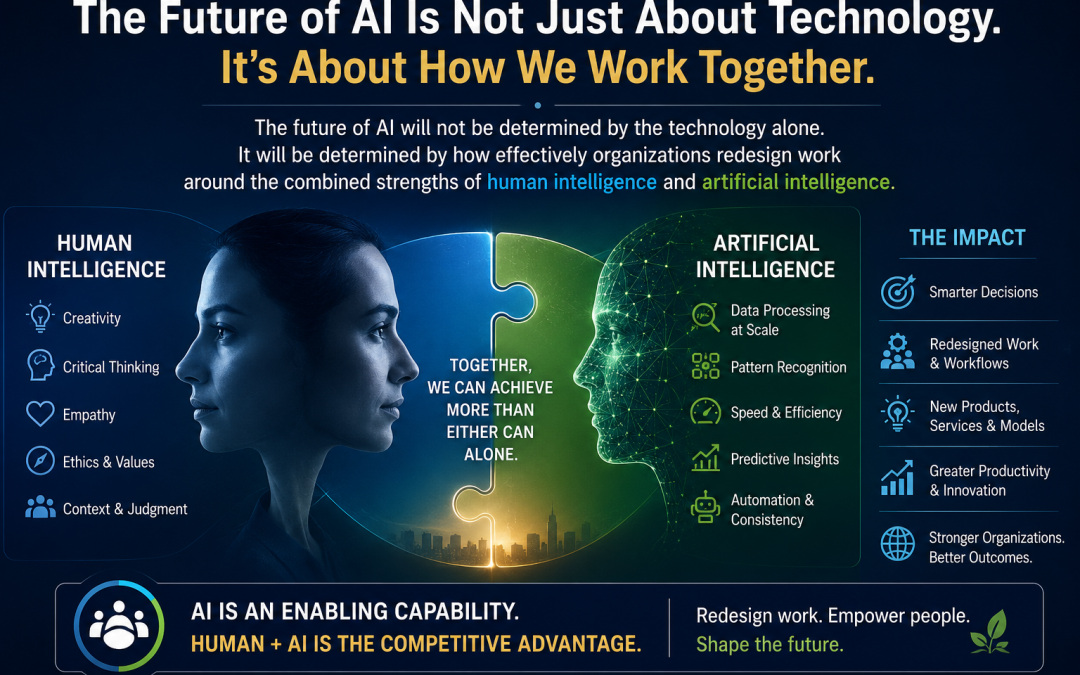
Artificial intelligence enhances these activities by helping professionals process larger volumes of information, identify patterns more quickly, explore alternative solutions, and reduce routine cognitive workload.
The future of work is therefore unlikely to be defined by humans competing with AI.
It will be defined by humans working more effectively because of AI.
Organizations that successfully integrate human judgment with artificial intelligence will be better positioned to innovate, adapt, and compete.
The Leadership Challenge
For CIOs, CEOs, consultants, and business leaders, the strategic question is no longer whether to adopt AI. That discussion is rapidly becoming obsolete.
The more important question is how organizations should redesign work so that AI becomes an enterprise capability rather than simply another software implementation.
This requires more than investing in technology.
It requires rethinking business processes, governance, workforce skills, organizational culture, and leadership. Organizations that treat AI merely as an efficiency tool may realize only incremental improvements. Those that recognize AI as a new layer of enterprise capability are more likely to lead the next phase of digital transformation.
Looking Beyond the Technology
Artificial intelligence is still evolving. Models will become more capable, infrastructure will improve, costs will decline, and entirely new applications will emerge.
History teaches us that the full impact of transformative technologies is rarely visible during their early years. Their greatest contributions often arise from innovations that were impossible to foresee when the technology first appeared.
Artificial intelligence is likely to be no different.
Its future will not be determined by the technology alone.
It will be determined by how effectively organizations redesign work to leverage the combined strengths of human and artificial intelligence.
This article is part of my AI Explained series, which explores Artificial Intelligence, Machine Learning, Large Language Models, Agentic AI, and the evolving relationship between humans and intelligent systems. The series is designed for business leaders, consultants, policymakers, educators, and professionals seeking a practical understanding of AI’s strategic implications.