
Early AI adoption is no longer confined to research laboratories or technology companies. It is rapidly becoming a strategic capability across every major sector of the global economy. While adoption varies across industries, a clear pattern has emerged: organizations that rely on knowledge, data, research, engineering, and digital content are leading the AI revolution.
Introduction
Artificial Intelligence (AI) has moved beyond experimentation. Organizations worldwide are integrating AI into their products, services, operations, and decision-making processes. However, AI adoption is not uniform.
Some industries are generating measurable business value today, while others are still building the governance, infrastructure, and workforce capabilities needed for large-scale implementation.
This raises an important question: Which industries are leading the adoption of Artificial Intelligence?
The answer depends on how success is measured. Some sectors lead in investment, others in deployment, and others in business value. Together, these indicators provide a useful picture of where AI is making the greatest impact.
Measuring AI Leadership
Industry leadership can be evaluated using several different indicators.
These include:
- Current adoption rates
- Business value created
- Investment in AI technologies
- Market spending
- Future growth potential
- Breadth of deployment across business functions
Although rankings differ slightly across studies, there is remarkable consistency regarding the industries at the forefront of AI adoption.
The First Wave of AI Leaders
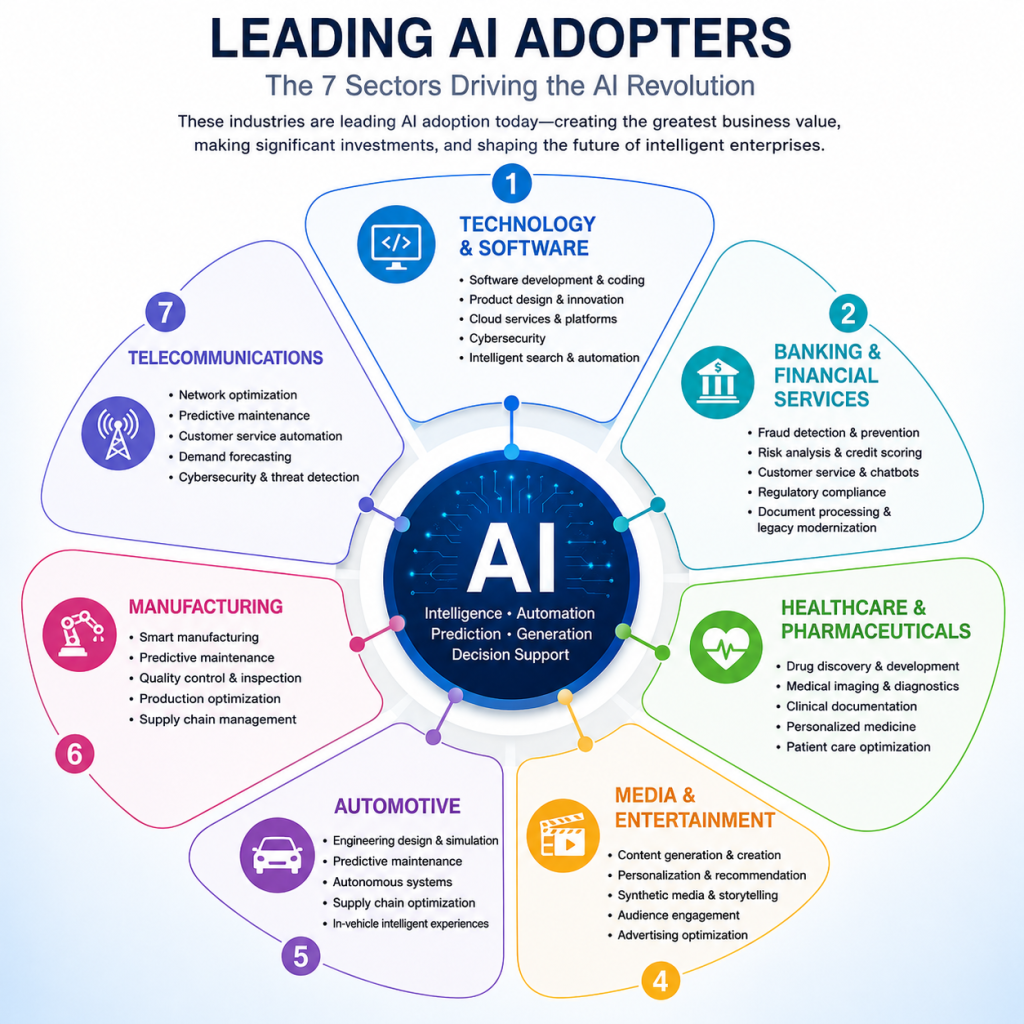
Research from McKinsey, Bain & Company, PwC, Grand View Research, Coursera, and other organizations identifies a common group of early adopters.
These include:
- Technology and Software
- Banking and Financial Services
- Healthcare and Pharmaceuticals
- Media and Entertainment
- Telecommunications
- Automotive
- Manufacturing
These sectors share one defining characteristic. They generate enormous quantities of digital information and depend heavily upon knowledge work, engineering, research, customer engagement, and complex decision-making.
How Different Industries Are Using AI
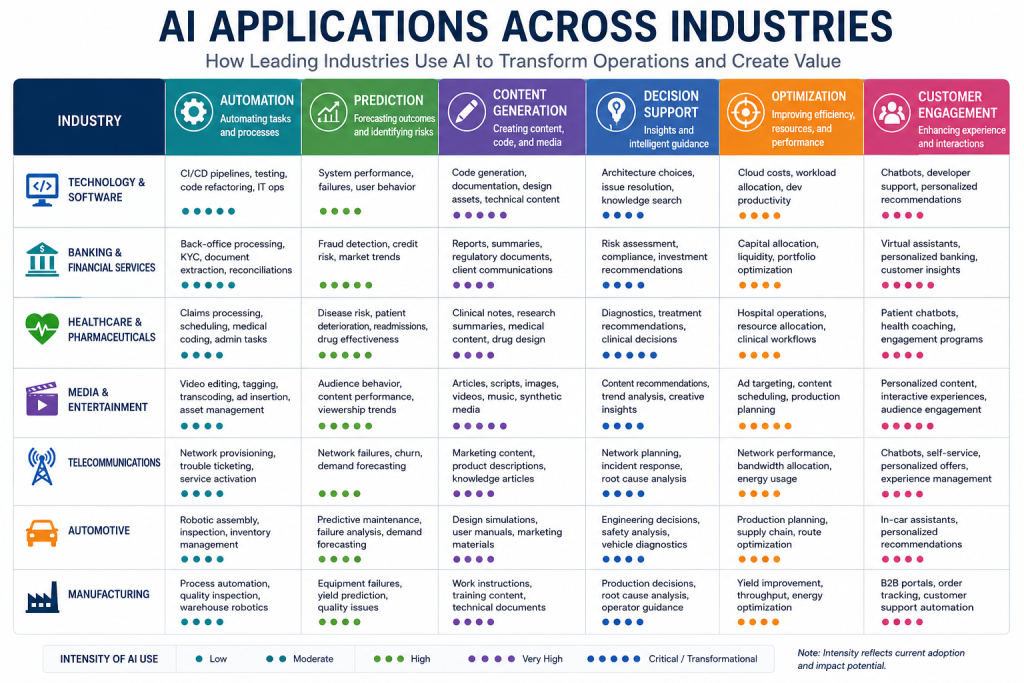
Although every industry uses AI differently, several common patterns have emerged.
Technology and Software
Technology companies were naturally among the earliest adopters. AI is widely used for:
- Software development
- Code generation
- Product design
- Cybersecurity
- Intelligent search
- Customer support
- Cloud services
Generative AI has significantly accelerated software engineering productivity while reducing development cycles.
Banking and Financial Services
Financial institutions have invested heavily in AI because of their dependence on data and analytical decision-making. Applications include:
- Fraud detection
- Risk analysis
- Regulatory compliance
- Credit assessment
- Customer service
- Document processing
- Legacy-system modernization
Many banks now view AI as a core competitive capability rather than simply another IT project.
Healthcare and Pharmaceuticals
Healthcare represents one of AI’s most promising application areas. Current uses include:
- Drug discovery
- Medical imaging
- Clinical documentation
- Diagnostic assistance
- Personalized medicine
- Hospital operations
Although highly regulated, healthcare offers enormous long-term value because of the volume and complexity of medical knowledge.
Media and Entertainment
Generative AI has transformed content-intensive industries. Media organizations increasingly use AI for:
- Content generation
- Image creation
- Video production
- Personalization
- Audience engagement
- Advertising optimization
- Translation and localization
Media and entertainment currently represent one of the largest end-user markets for generative AI.
Automotive and Manufacturing
Manufacturers have embraced AI to improve productivity and operational efficiency. Applications include:
- Engineering design
- Predictive maintenance
- Supply-chain optimization
- Quality control
- Robotics
- Autonomous systems
Industrial AI is helping organizations reduce costs while improving reliability and production performance.
Telecommunications
Telecommunications providers employ AI for:
- Network optimization
- Predictive maintenance
- Customer service
- Demand forecasting
- Cybersecurity
- Intelligent network management
As communications infrastructure becomes increasingly software-defined, AI is becoming central to network operations.
Marketing and Sales Lead AI Adoption
Across industries, one business function consistently stands out. Marketing and Sales remain the most widely adopted applications of generative AI.
Organizations use AI to:
- Generate marketing content
- Personalize customer experiences
- Analyze customer behavior
- Produce product descriptions
- Optimize advertising campaigns
- Improve sales productivity
This reflects AI’s exceptional ability to process language, generate content, and support customer interactions.
Why Some Industries Move Faster Than Others
Interestingly, industries with the greatest potential do not always achieve the fastest adoption. Highly regulated sectors such as healthcare, banking, and pharmaceuticals face additional challenges, including:
- Privacy requirements
- Data governance
- Security concerns
- Ethical considerations
- Regulatory compliance
- Cultural resistance
Successful AI adoption, therefore, depends not only on technology but also on organizational readiness.
AI Is Becoming a Strategic Capability
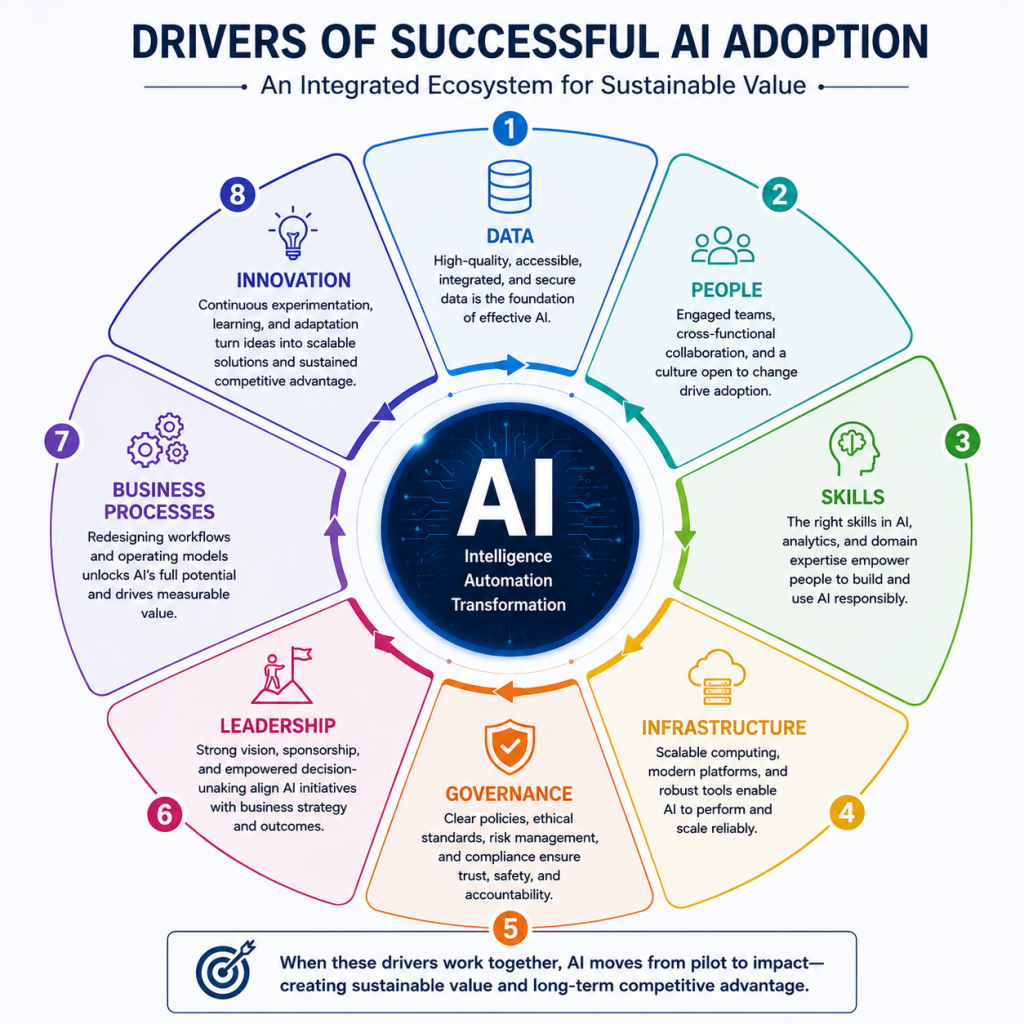
One important conclusion emerges from virtually every major study. Organizations creating the greatest value from AI are not simply deploying new software. They are redesigning the way they work. Successful AI adoption typically combines:
- Digital transformation
- Process redesign
- Workforce development
- Data quality improvement
- Governance frameworks
- Leadership commitment
- Continuous learning
AI is becoming less of an IT initiative and more of a strategic business capability.
Looking Ahead
Artificial Intelligence is still in its early stages. As Large Language Models, multimodal AI, and autonomous AI agents continue to mature, adoption will spread rapidly across industries that have so far remained cautious. The most successful organizations are unlikely to be those with the largest AI budgets. Instead, they will be those that combine technology with skilled people, effective governance, high-quality data, and redesigned business processes.
The future of AI will not be defined by which industries adopt it. It will be defined by how effectively every industry learns to work alongside intelligent systems.
References
- McKinsey & Company. How AI Is Transforming Six Major Industries.
- Strategy& (PwC). Generative AI Industry Insights.
- Coursera. Generative AI Applications.
- Bain & Company. Which Industries and Countries Are Getting the Most Out of Generative AI?
- Energy Economics (ScienceDirect). Artificial Intelligence Adoption and Economic Impacts.
- Grand View Research. Generative AI Market Report.