
Evolution of Artificial Intelligence (AI) from research laboratories into everyday life has happened over decades. Today, professionals use AI to write reports, analyze data, generate software code, conduct research, create images, summarize complex documents, and support decision-making.
Unlike previous generations of software, modern AI systems understand and generate natural language, allowing people to interact with computers almost as they would with another human being. This represents one of the most significant developments in the history of computing.
While AI has existed as a scientific discipline for nearly seventy years, recent advances—particularly Large Language Models (LLMs)—have made AI accessible to millions of people without requiring programming skills.
This article explains how AI has evolved, why it matters, and why organizations worldwide are investing heavily in AI capabilities.
What Is Artificial Intelligence?
Artificial Intelligence refers to computational systems capable of performing tasks traditionally associated with human intelligence.
These capabilities include:
- Learning from data
- Reasoning
- Language understanding
- Pattern recognition
- Problem solving
- Decision support
- Content generation
Unlike conventional software that follows predefined rules, AI systems can identify patterns, adapt to new information, and assist humans in solving increasingly complex problems.
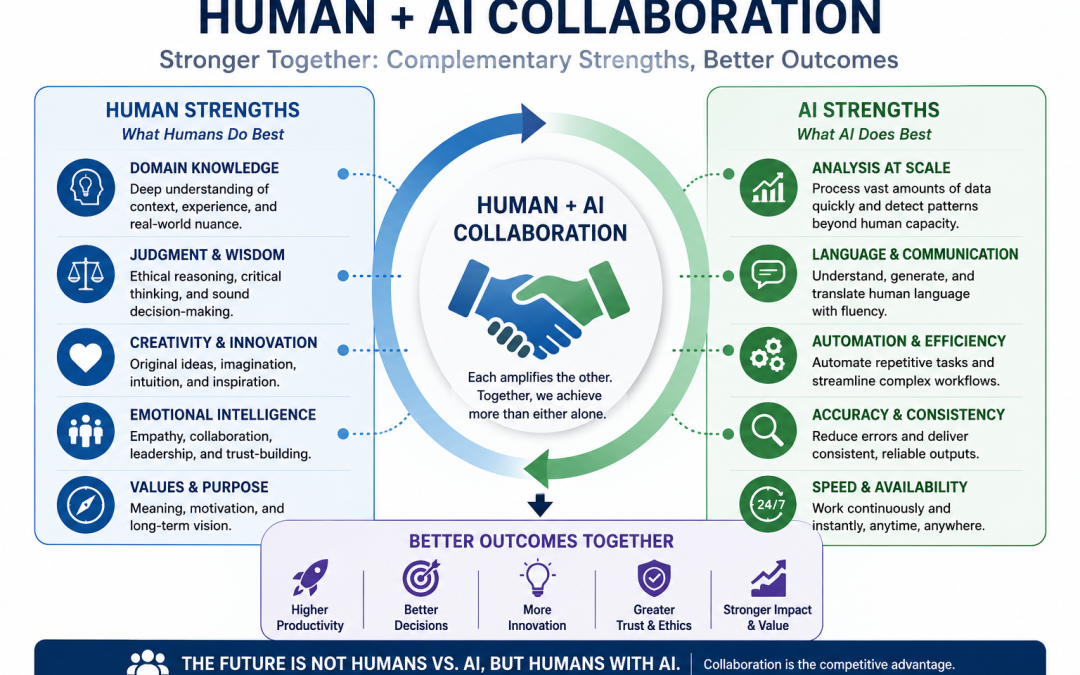
Today, AI is best viewed as a technology that augments human intelligence rather than replacing it.
A Brief History of AI
The foundations of Artificial Intelligence were established during the 1940s and early 1950s through advances in mathematics, logic, cybernetics, and computing.
The field officially began in 1956, when John McCarthy coined the term “Artificial Intelligence” during the Dartmouth Summer Research Project on Artificial Intelligence. Over the following decades AI evolved through several major phases:
- Symbolic AI
- Expert Systems
- Machine Learning
- Deep Learning
- Generative AI
The most significant breakthrough in recent years occurred in 2017 with the introduction of the Transformer architecture.
This innovation dramatically improved computers’ ability to understand and generate natural language, leading to today’s foundation models such as GPT, Claude, Gemini, and Llama.

Why Large Language Models Changed Everything
For decades, computers required people to communicate through programming languages or complex software interfaces. Large Language Models changed this relationship. Instead of learning how computers think, people can now communicate with machines using everyday language. This seemingly simple change has profound consequences.
Natural language has become the new interface between humans and computers. As a result, AI is no longer restricted to software engineers and data scientists. Researchers, teachers, consultants, lawyers, doctors, designers, students, and business leaders can now use AI directly to improve their productivity.

AI Is Becoming a General-Purpose Technology
Economists describe technologies such as the steam engine, electricity, the internet, and cloud computing as General-Purpose Technologies (GPTs) because they transform nearly every sector of the economy.
Artificial Intelligence is increasingly being viewed in the same way. Rather than serving a single industry, AI is becoming an enabling capability across almost every discipline.
Examples include:
- Healthcare
- Agriculture
- Education
- Finance
- Manufacturing
- Scientific Research
- Government
- Law
- Marketing
- Software Development
AI is evolving into the knowledge infrastructure of the digital economy.
AI and Productivity
The greatest value of AI lies not in replacing people but in enabling them to perform knowledge-intensive work more effectively.
AI can help professionals:
- Research faster
- Write more effectively
- Analyze larger volumes of information
- Generate ideas
- Create presentations
- Produce software
- Support strategic decisions
- Automate repetitive workflows
The World Economic Forum notes that AI has the potential to become one of the largest drivers of productivity growth in modern economic history.
However, these gains will depend on complementary investments in digital infrastructure, workforce skills, organizational change, and business process redesign.
Organizations that successfully integrate AI into everyday work are likely to realize significant long-term competitive advantages.

AI Is a Strategic Capability
Increasingly, governments view AI as a strategic national capability rather than merely another digital technology.
Countries investing heavily in AI seek to:
- Increase productivity
- Strengthen economic competitiveness
- Accelerate scientific discovery
- Improve public administration
- Enhance national security
- Develop new industries
- Promote innovation
Leadership in AI depends upon an entire innovation ecosystem including universities, research institutions, semiconductor capability, venture capital, cloud computing infrastructure, entrepreneurial culture, skilled talent, and supportive public policy.
This explains why the United States and China currently dominate the global AI landscape.
Looking Ahead
Artificial Intelligence is still in its early stages.
The emergence of Large Language Models has democratized access to sophisticated computing capabilities, but the next wave is already underway.
AI agents, multimodal systems, autonomous workflows, and intelligent knowledge platforms are expected to reshape the future of work over the coming decade.
For individuals and organizations alike, the most valuable investment may no longer be learning every new AI tool.
Instead, it will be developing the ability to collaborate effectively with intelligent systems. AI is not replacing human intelligence. It is expanding what human intelligence can accomplish.
Further Reading
Artificial Intelligence Fundamentals
- Google Cloud – What is Artificial Intelligence?
- McKinsey – What is AI?
- NASA – What is Artificial Intelligence?
- Stanford University – What is AI?
- ISO – Artificial Intelligence
History of Artificial Intelligence
- Dartmouth College – History of AI
- IBM – History of Artificial Intelligence
- Stanford AI100 Project
- Encyclopedia Britannica – History of Artificial Intelligence
Large Language Models
- Microsoft Azure – What Are Large Language Models?
- Toloka – History of LLMs
- Dataversity – Brief History of LLMs
AI Strategy and Productivity
- World Economic Forum – The Where and When of AI Making Us More Productive, According to Experts
- Brookings Institution – The Global AI Race
- Boston Consulting Group – US–China AI Strategy