Foundation Models and Generative AI: Understanding the Difference and the Business Connection is fundamental to our understanding of AI. Generative AI has quickly become one of the most discussed areas of artificial intelligence. It is transforming how individuals and organizations create content, automate work, and solve business problems.
Yet, in many discussions, two important terms are often used interchangeably: foundation models and generative AI. They are closely related, but they are not the same thing.
Understanding the distinction is important for anyone seeking to use AI strategically in business, education, research, or public administration.
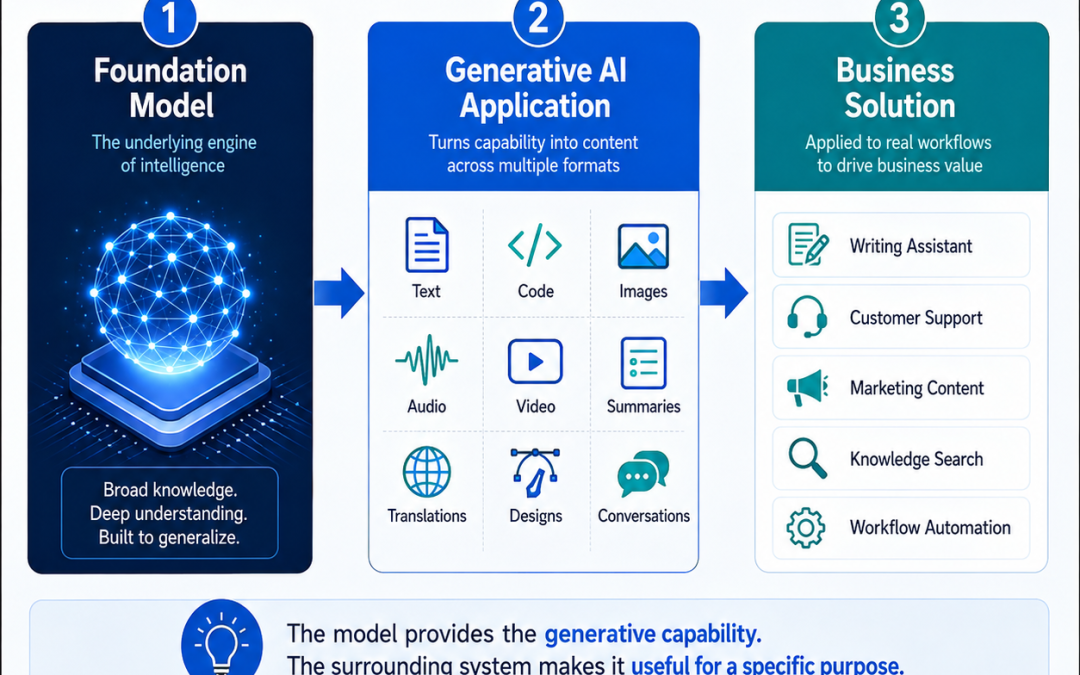
A simple way to think about the relationship is this:
Foundation Model
↓
Generative AI Application
↓
Business Solution
In other words, the foundation model provides the core capability, the generative-AI application makes that capability usable, and the business solution applies it to a practical purpose.
What Is a Foundation Model?
A foundation model is a large, general-purpose AI model trained on vast amounts of data. It is called a foundation model because it serves as a base or foundation on which many different AI applications can be built.
These models are designed to learn broad patterns, structures, relationships, and representations from large datasets. Because of this, they can support a wide range of tasks rather than being limited to a single narrow function.
A foundation model is therefore the underlying engine behind many modern AI systems.
What Is Generative AI?
Generative AI is a branch of artificial intelligence that can create new content in response to a user’s prompt or other input.
That content may include:
- Text
- Software code
- Images
- Audio
- Speech
- Video
- Animations
- Summaries
- Translations
- Designs
- Conversations
- Simulations
- Three-dimensional models
- Synthetic data
- Molecular and protein structures
Generative AI systems learn from large collections of existing data. They do not merely store and retrieve that information. Instead, they learn patterns, structures, styles, and relationships from the data and then use that learning to produce new outputs.
This is why the term generative is used. The system is able to generate something new.
The Relationship Between Foundation Models and Generative AI
A foundation model and a generative-AI application are not identical.
The foundation model is the underlying model.
The generative-AI application is the user-facing system developed around that model.
The model supplies the broad intelligence and generative capability. The application wraps that capability in a usable environment for a specific audience or purpose.
For example, a business writing assistant may be built around:
- A foundation model
- A user interface
- Organizational documents
- Retrieval technology
- Prompt instructions
- Security controls
- Human review
- Output-management tools
In this case, the foundation model provides the general ability to generate language. The surrounding application makes that ability useful in a practical context such as drafting business communication, summarizing reports, or supporting internal knowledge work.
This distinction is critical in business settings. A model alone does not automatically create value. It becomes valuable when embedded in a system, workflow, or application designed to solve a real problem.
From Model to Business Solution
Many organizations are now moving beyond experimentation with AI tools and asking a more important question:
How do we convert AI capability into business value?
This is where the progression becomes important:
1. Foundation Model
This is the core model that provides the base intelligence and generative capability.
2. Generative AI Application
This is the system built around the model to perform useful tasks such as writing, summarization, coding, translation, or conversational support.
3. Business Solution
This is the application of the generative-AI system within a real workflow, process, or organizational function.
Examples of business solutions may include:
- Enterprise writing assistants
- Customer-support systems
- Knowledge-search tools
- Marketing-content generators
- Workflow-automation systems
- Research and analysis support systems
The real business impact comes not merely from the model, but from how well the overall system is aligned with a practical need.
How Generative AI Differs from Traditional AI
To understand why generative AI matters, it helps to compare it with more traditional forms of AI. Traditional artificial-intelligence systems have often been designed to:
- Analyze information
- Classify observations
- Detect patterns
- Make predictions
- Recommend decisions
Examples include:
- Classifying an email as spam or legitimate
- Predicting whether a customer may leave a service
- Identifying an object in a photograph
- Detecting a fraudulent transaction
- Forecasting product demand
- Recommending a product or a film
These systems typically answer questions such as:
- What category does this item belong to?
- What is likely to happen next?
- Is this transaction unusual?
- Which option should be recommended?
Generative AI goes a step further.
Instead of only analyzing or predicting, it uses learned patterns to produce a new output.
For example:
- A predictive system may estimate which customers are likely to respond to a campaign.
- A generative system may write a personalized email for each customer.
Or:
- A conventional vision system may identify the objects in an image.
- A generative vision system may create a new image from a written description.
Or:
- A code-analysis system may detect a software defect.
- A generative coding system may propose corrected code.
This shift—from analysis to creation—is what makes generative AI so powerful and so disruptive.
Is the Distinction Absolute?
Not entirely. Generative AI systems themselves depend heavily on prediction.
For instance, a large language model generates text by repeatedly predicting a likely next token. In that sense, prediction is still central to how the system works.
The difference lies in the purpose and final output. Traditional AI mainly uses prediction to classify, forecast, detect, or recommend. Generative AI uses prediction as part of a process that creates new content.
That is why generative AI can be seen as an extension of AI capability rather than a complete break from earlier forms of AI. It builds on familiar machine-learning principles but applies them to produce original outputs.
Why This Matters for Organizations
For business leaders and professionals, the distinction between foundation models and generative-AI applications is not merely academic. It has practical implications.
Organizations need to understand that:
- A foundation model is not, by itself, a finished business solution.
- Business value depends on how the model is integrated into workflows, data environments, and governance structures.
- User interface, retrieval systems, organizational data, prompt design, human review, and security controls often determine whether an AI application is effective and trustworthy.
- Successful generative AI use requires both technical capability and organizational design.
In other words, the surrounding system matters just as much as the model.
This is especially true in enterprise contexts where reliability, accuracy, privacy, compliance, and oversight are essential.
Final Thought
Foundation models provide the technological engine behind most modern generative-AI systems.
Generative AI uses those models to create new content.
But the real value emerges only when that capability becomes a user-facing application and is applied to a meaningful business problem.
That is why the progression is so important:
Foundation Model
↓
Generative AI Application
↓
Business Solution
As organizations continue to explore AI, understanding this relationship will help them move from curiosity and experimentation to purposeful adoption.
The future of AI will not be shaped only by the model’s power. It will also be shaped by how intelligently that power is applied.