What Are Foundation Models? Understanding the Technology Behind Modern Generative AI
Foundation models represent one of the most important developments in modern artificial intelligence. They form the technological base for many of today’s generative AI systems, AI assistants, copilots, multimodal applications, and increasingly AI agents.
Their importance lies in a fundamental shift in how AI systems are developed. Instead of training a completely new machine-learning model for every task, developers can start with a large model already trained on broad, diverse data. They can then adapt that model to many different applications.
In simple terms:
Broad Data → Pretrained Foundation Model → Adaptation → Many Applications
This ability to reuse and adapt a common technological foundation has transformed the economics, speed, and possibilities of AI development.
From Task-Specific AI to General-Purpose AI
Traditional machine-learning models were generally designed for narrowly defined tasks.
An organization might build one model for:
- Fraud detection
- Demand forecasting
- Image classification
- Credit-risk assessment
- Customer churn prediction
Each application could require its own dataset, model architecture, training process, testing system, and deployment infrastructure.
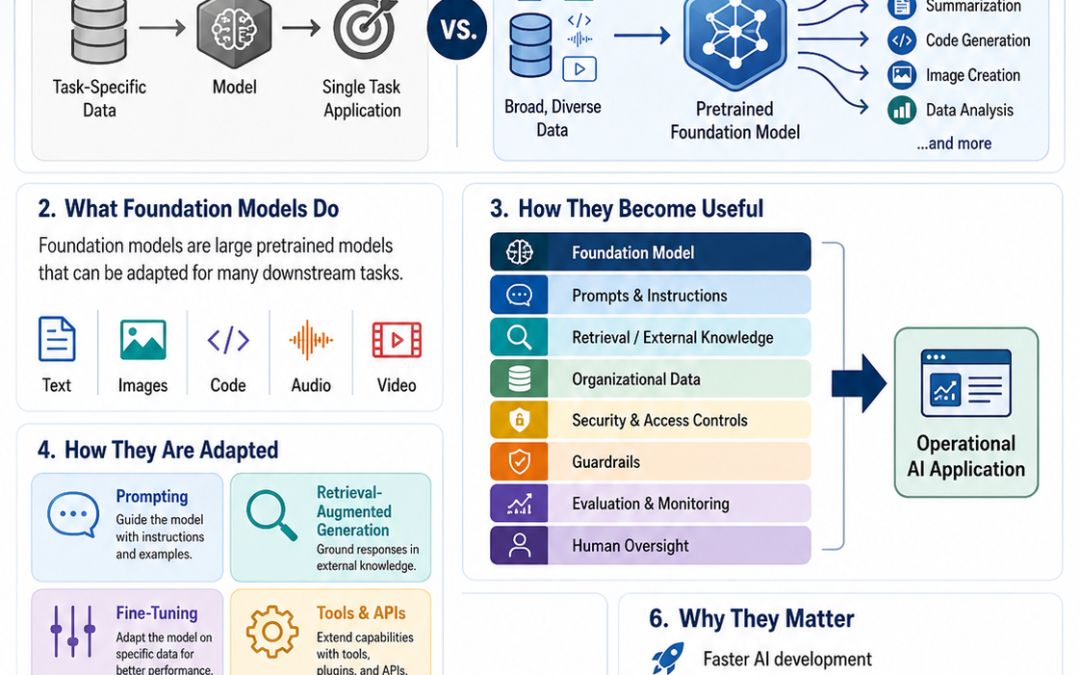
Foundation models represent a different approach. A large model is first trained on enormous quantities of information. Depending on its design, this data may include text, images, code, audio, video, structured information, or combinations of several modalities.
During this process, the model learns statistical patterns, relationships, representations, and structures present in the training data. Instead of being restricted to one narrowly defined task, the resulting model can provide capabilities that are useful across many applications.
The shift can therefore be summarized as:
Traditional AI
One dataset → One model → One task
Foundation-model paradigm
Broad data → One pretrained model → Many possible applications
This reuse is a defining characteristic of foundation models.
The Foundation-Model Paradigm
Researchers at Stanford University’s Center for Research on Foundation Models introduced the term foundation model in 2021.
Their influential report, On the Opportunities and Risks of Foundation Models, described a foundation model as one trained on broad, large-scale data and adaptable to a wide range of downstream tasks.
Examples discussed during the paradigm’s emergence included systems such as BERT, GPT-3, DALL-E, and CLIP.
The word foundation was deliberately chosen.
These models provide a common technological base upon which many other AI systems can be constructed.
But the foundation should not be confused with the finished application.
A foundation model provides capabilities. An operational AI system usually requires much more.
A Foundation Model Is Not the Final Application
Organizations rarely deploy a raw foundation model on its own. To turn broad model capabilities into a useful application, developers may add:
- Prompts and instructions that guide model behavior.
- Organizational or domain-specific information that gives the system relevant context.
- Retrieval systems that allow the model to access approved documents or databases.
- Fine-tuning or other adaptation techniques that specialize the model for particular tasks.
- Software tools and APIs that connect the model to external systems.
- Security and access controls that determine what information and functions users can access.
- Evaluation and monitoring systems that measure performance and identify failures.
- Guardrails and governance mechanisms that help control inappropriate or unsafe behavior.
- Human oversight for review, approval, judgment, and accountability.
A foundation model should therefore be understood as an enabling layer rather than the entire AI solution.
How Foundation Models Are Adapted
You can adapt the broad capabilities learned during pretraining in several ways.
Prompting
Users provide instructions, examples, context, or constraints that guide the model toward a particular task. This is often the fastest way to adapt an existing model.
Retrieval-Augmented Generation
Retrieval systems allow a model to access external information before generating a response. For example, an enterprise research assistant might retrieve documents from an approved corporate knowledge base and provide them as context to the model. The foundation model itself may remain unchanged while the application becomes highly specialized.
Fine-Tuning
A pretrained model can also be further trained on additional examples relevant to a particular task or domain. Fine-tuning can help modify model behavior or improve performance for specialized applications.
Tools and External Systems
Modern foundation models can increasingly be connected to software tools, databases, APIs, search systems, calculators, and enterprise applications.
This extends the model beyond generating information and allows it to participate in operational workflows.
Why Foundation Models Changed AI Development
The foundation-model paradigm offers potentially significant economies of scale. Training frontier-scale models requires enormous computational resources, data, technical expertise, and capital.
But once such a model exists, many organizations can build applications by adapting its underlying capabilities rather than training equivalent models from scratch. This can reduce the time and infrastructure required to develop AI applications.
The same foundation model may potentially contribute to systems for:
- Writing and communication
- Software development
- Scientific research
- Healthcare
- Education
- Customer support
- Business analysis
- Image interpretation
- Earth observation
- Industrial operations
This does not mean that one model performs every task equally well.
Instead, the same underlying foundation can support many downstream applications when combined with appropriate adaptation, data, tools, evaluation, and oversight.
Emergence: Capabilities That Appear With Scale
The Stanford foundation-model framework highlighted emergence as an important characteristic of this new paradigm. As models increase in scale and are trained on broader information, they may demonstrate capabilities that were not individually programmed into the system.
These may include abilities related to:
- Few-shot adaptation
- Prompt-based task performance
- Content generation
- Cross-modal processing
- More complex forms of problem solving
The important point is that model capability does not always increase in simple or completely predictable ways.
New capabilities may appear as model scale, architecture, training data, and training methods change.
This makes foundation models powerful—but it also makes systematic evaluation increasingly important.
Homogenization: One Foundation, Many Systems
A second important consequence identified in the Stanford framework is homogenization. When many organizations build applications using the same underlying models, AI development becomes more standardized.
This creates substantial benefits. Developers can reuse powerful capabilities instead of recreating them independently for every application. However, reuse also creates systemic risks.
If an underlying foundation model contains:
- Biases
- Security vulnerabilities
- Reliability problems
- Factual weaknesses
- Design limitations
these weaknesses may affect many downstream applications built upon it.
A problem in one widely used foundation can therefore propagate across numerous systems.
The same feature that creates economies of scale can also create concentrated technological risk.
Foundation Models Are Sociotechnical Systems
Foundation models should therefore not be viewed simply as engineering artifacts. Their development and deployment affect organizations, professions, institutions, and societies. Important questions arise around:
- Accuracy and reliability
- Privacy
- Intellectual property
- Security
- Bias and fairness
- Transparency
- Accountability
- Employment and job redesign
- Education
- Regulation
- Human oversight
Understanding foundation models consequently requires more than computer science. Their responsible development increasingly involves expertise from law, ethics, economics, medicine, education, public policy, social science, organizational management, and many other disciplines. This is why foundation models can appropriately be described as part of a broader sociotechnical system.
From Foundation Model to Business Application
For organizations, perhaps the most important distinction is between the underlying model and the application created from it.
Consider an enterprise research system.
The foundation model may provide capabilities such as language understanding, summarization, comparison, and generation.
But the actual research application might combine that model with:
Foundation Model
↓
Retrieval from Approved Information
↓
Organizational Data and Documents
↓
Prompts and Workflow Instructions
↓
Security and Access Controls
↓
Evaluation and Guardrails
↓
Human Review
↓
Research Application
The value comes not merely from possessing access to a powerful model.
It comes from designing the entire system around the model.
The Central Lesson
Foundation models have changed AI architecture.
The earlier paradigm was largely:
One model → One task
The emerging paradigm is increasingly:
One broad foundation → Many capabilities → Many applications
But a foundation model remains exactly that—a foundation.
Turning its capabilities into reliable, useful, and responsible applications requires adaptation, contextual information, software integration, evaluation, governance, and human judgment.
Understanding this distinction is essential for understanding modern generative AI. The future of AI will therefore depend not only on building increasingly capable foundation models. It will also depend on how intelligently, safely, and responsibly we build systems upon them