
Generative AI: Understanding Models, Capabilities, and Applications
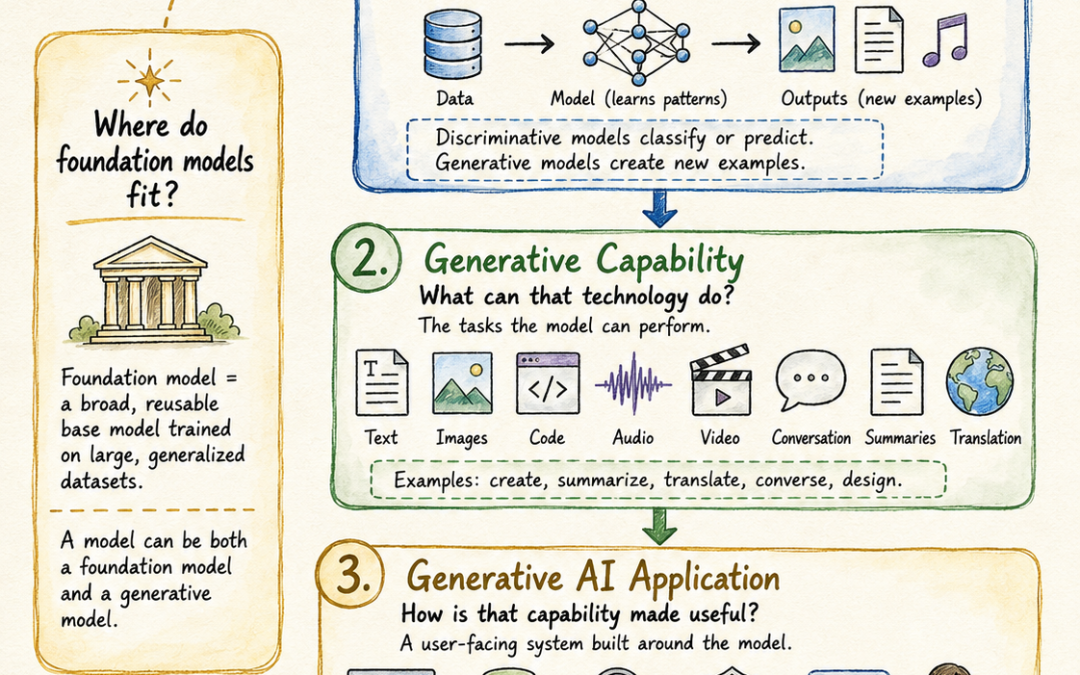
Generative AI is often discussed as though it were a single technology. In reality, several layers sit between an underlying AI model and the practical system a person or organization eventually uses. Three concepts are particularly useful for understanding this distinction:
- Generative model: What technology produces the output?
- Generative capability: What can that technology do?
- Generative AI application: How is that capability made useful to a person or organization?
These concepts are related, but they describe different parts of the Generative AI ecosystem.
A simple way to visualize the progression is:
Generative Model
↓
Generative Capability
↓
Generative AI Application
↓
Practical Use
Understanding these layers becomes increasingly important as organizations move from experimenting with AI tools to designing applications around them.
What Is a Generative Model?
A generative model is a trained machine-learning model that learns patterns, structures, and relationships within data and uses those learned representations to create new outputs. Traditional machine-learning systems have often been designed primarily for classification or prediction.
For example, a discriminative model might be trained to determine whether an image contains a dog or a cat. A generative model goes further. It learns enough about the characteristics and relationships within the training data to construct a new example.
For instance, it might generate an image of an animal that did not exist in the original training dataset. The same basic idea can apply to many types of information.
Depending on the model architecture and its training, generative models may produce:
- Text
- Images
- Software code
- Audio
- Speech
- Music
- Video
- Designs
- Synthetic data
- Other forms of digital content
The model is therefore the underlying technological engine responsible for generation.
Generative Models Versus Discriminative Models
The distinction between generative and discriminative models helps explain why Generative AI represents an important development in machine learning.
A discriminative model generally attempts to distinguish between categories or predict an outcome.
It may answer questions such as:
- Is this email spam?
- What object appears in this photograph?
- Is this transaction fraudulent?
- Which customer is likely to leave?
- What is the probability of a particular outcome?
A generative model, by contrast, can create a new output based on patterns learned during training.
It may:
- Write an article
- Generate software code
- Produce an image from a description
- Compose music
- Create a summary
- Generate a conversational response
This does not mean prediction disappears.
Large language models, for example, generate language partly through repeated prediction of likely next tokens. Prediction remains part of the technical process.
What changes is the purpose of the system and the form of its output.
What Is a Generative Capability?
The model provides the underlying technology. Generative capability describes what that technology can do.
A model may possess capabilities such as:
- Generating text
- Summarizing documents
- Translating languages
- Writing software code
- Creating images
- Producing audio
- Generating video
- Conducting conversations
- Extracting information
- Rewriting content
- Producing designs
- Supporting analysis
This distinction matters because the same model may have many capabilities. For example, a large multimodal model might analyze text, interpret images, generate written content, summarize documents, and answer questions.
Those are capabilities of the underlying model. They are not yet, by themselves, business applications.
What Is a Generative AI Application?
A Generative AI application is the user-facing system built around a model and its capabilities.
This is the layer through which a person or organization actually uses Generative AI.
The application may combine the underlying model with other technologies and controls.
For example, an enterprise knowledge assistant might include:
- A foundation or generative model
- A user interface
- Organizational documents
- Retrieval technology
- Prompt instructions
- Access controls
- Security safeguards
- Workflow logic
- Human review
- Output-management tools
The model might already possess the capability to answer questions.
But connecting that capability to organizational documents, retrieval systems, permissions, and human oversight turns it into an application that can serve a particular business purpose.
This distinction becomes especially important in enterprise AI.
A powerful model is not automatically a useful business solution.
From Capability to Practical Use
Consider several examples.
Writing
The model can generate language. A writing application combines that capability with:
- Templates
- Organizational terminology
- Style instructions
- Workflow controls
- Human editing
The result may become an enterprise writing assistant.
Customer Support
The model possesses conversational and summarization capabilities.
The application may add:
- Company knowledge
- Customer records
- Retrieval systems
- Escalation rules
- Security controls
- Human agents
The result becomes a customer-support solution.
Knowledge Search
The model can understand questions and generate responses.
The application adds:
- Internal documents
- Search or retrieval technology
- Access permissions
- Citations
- Verification mechanisms
The result becomes an organizational knowledge assistant.
In each case, the underlying capability may be similar, but the application is designed around a particular need.
Where Do Foundation Models Fit?
The relationship between foundation models and generative models can create confusion because many modern systems fall into both categories.
However, the terms describe different characteristics.
A foundation model is generally distinguished by its:
- Breadth
- Scale
- General-purpose training
- Ability to support multiple downstream tasks
- Reusability across applications
A generative model is distinguished by its ability to learn patterns and generate new outputs.
The distinction can therefore be summarized as:
Foundation model → describes breadth, scale, and reusability
Generative model → describes the model’s ability to generate
A model can be both.
Many modern large language models are simultaneously:
- Foundation models, because they can support many tasks and applications; and
- Generative models, because they can create new content.
The concepts overlap, but they are not identical.
Foundation Models as the Base for Generative AI Applications
Many modern Generative AI systems begin with a foundation model.
The foundation model provides broad capabilities.
Developers and organizations then build applications around those capabilities.
The progression may therefore look like this:
Foundation Model
↓
Generative Capabilities
↓
Application Layer
↓
Organizational Data and Tools
↓
Business Solution
This helps explain why two applications built on the same underlying foundation model can behave very differently.
Their performance may depend not only on the model but also on:
- Data
- Retrieval
- Prompt design
- System architecture
- User interface
- Security
- Governance
- Human oversight
- Evaluation procedures
The model matters, but so does everything built around it.
Why the Distinction Matters for Organizations
Organizations considering Generative AI often begin by asking:
Which model should we use?
That is important, but it is only one part of the decision.
They must also ask:
What capability do we require?
and then:
How should that capability be converted into a reliable application?
For example, an organization may require the capability to summarize technical documents. The real business problem is not simply finding a model that can summarize text. The organization may also need:
- Access to internal documents
- Reliable retrieval
- Protection of confidential information
- Source citations
- Appropriate permissions
- Quality evaluation
- Human review
The business value comes from the complete system, not from the model alone.
Model Capability Is Not the Same as Application Performance
This distinction also helps explain why demonstrations of AI capability should not automatically be interpreted as proof that a system is ready for operational deployment.
A model might demonstrate impressive capabilities under controlled conditions.
An application built around that model must still address questions such as:
- Is the output accurate enough?
- Does the system have access to the right information?
- Is sensitive information protected?
- Can users understand when AI is being used?
- Are outputs verified?
- Who is accountable for mistakes?
- What happens when the system encounters an unfamiliar situation?
- When should a human intervene?
Generative capability tells us what may be technically possible.
Application design determines whether that capability can be used safely, reliably, and productively.
The Bigger Picture
The Generative AI ecosystem is easier to understand when these layers are separated.
Generative Model
The trained machine-learning model that produces new outputs.
Generative Capability
The tasks the model can perform.
Generative AI Application
The system that makes those capabilities accessible and useful.
Business or Practical Use
The workflow or organizational problem to which the application is applied.
Foundation models sit underneath many of these systems, providing broad capabilities that can support multiple applications.
The resulting picture is:
Model → Capability → Application → Practical Use
This progression also shifts attention away from AI as merely a collection of impressive technologies.
The more important question becomes how those technologies are assembled into systems that create useful outcomes.
Final Thought
The model provides the underlying intelligence. The capability describes what that intelligence can do. The application determines how people can use it. And the surrounding workflow determines whether it creates real value. As Generative AI becomes more deeply embedded in professional work, understanding these distinctions will matter more.
Organizations will not succeed with AI simply by selecting the most powerful model.
They will succeed by identifying the right capabilities, building appropriate applications around them, integrating those applications into real workflows, and applying suitable governance and human oversight.
That is where technological capability becomes practical value.