Generative AI Applications: How Models Become Operationally Useful. Generative AI is often discussed as though the model and the application were the same thing. They are not.
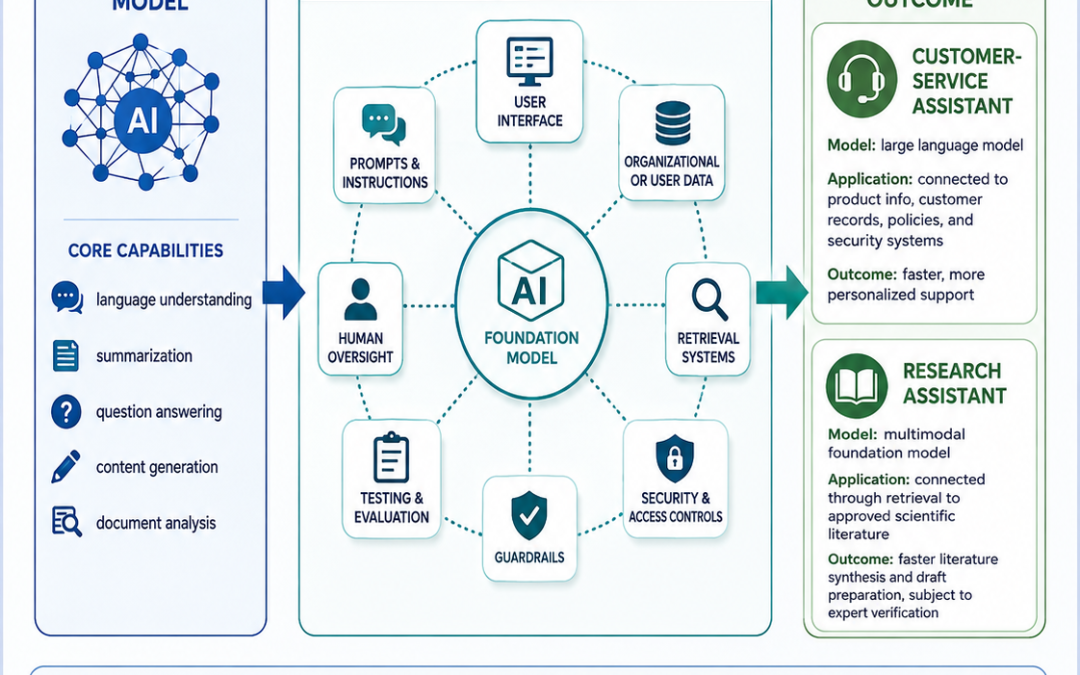
A foundation model provides underlying capabilities such as language understanding, summarization, question answering, document analysis, image interpretation, and content generation. A Generative AI application takes one or more of these capabilities and combines them with data, interfaces, controls, and workflows to accomplish a specific task or solve a particular problem.
Understanding this distinction is important because much of the practical value of Generative AI emerges at the application level.
From Foundation Model to Generative AI Application
A foundation model may be powerful, but access to a model alone does not create an operational solution.
A practical Generative AI application typically includes more than the model itself. It may combine the foundation or generative model with a user interface, prompts and instructions, organizational or user data, retrieval systems, security and access controls, guardrails, testing and evaluation processes, and human oversight.
The model provides the underlying intelligence. The surrounding application determines how it uses that intelligence.
This can be represented simply as:
Foundation Model + Data + Instructions + Retrieval + Controls + Evaluation + Human Oversight = Generative AI Application
The distinction also separates access to foundation models from the considerably broader task of building and scaling applications for particular customers, organizational data, workflows, and use cases.
Customer Service Example
Consider an AI-enabled customer-service system.
The underlying model could be a large language foundation model that can understand language, answer questions, summarize information, and generate text. Those capabilities alone do not constitute a customer-service application.
The application emerges when the model is connected to company product information, customer records, organizational policies, security systems, workflow rules, and an interface through which customers or employees can interact with it.
The resulting business outcome could be faster and more personalized customer support.
The progression is therefore:
Model → Capabilities → Application → Business Outcome
The model provides the technology. The application converts that technology into operational value.
Research Example
The same distinction applies to scientific and professional research. A multimodal foundation model may be able to read documents, extract information, summarize findings, compare evidence, and generate text.
A research application could connect those capabilities through a retrieval system to an approved collection of scientific literature. Additional controls could determine which sources the system can use, how it evaluates results, and when expert verification is required.
The professional outcome could be faster literature synthesis and research draft preparation, while retaining human responsibility for verification and judgment. Again, the value does not come from the model alone. It comes from the way the model is integrated into the research process.
One Model Can Support Many Applications
This distinction has an important practical implication. Creating a new Generative AI application does not necessarily require training another foundation model. The same underlying model may support a customer-service assistant, research system, writing assistant, knowledge-management tool, document-analysis application, or many other use cases.
What changes is the application layer around the model: the data, instructions, retrieval mechanisms, interfaces, controls, evaluation methods, and workflows.
Organizations should therefore avoid equating model selection with application design.
Selecting a capable model is only one part of the process.
The Application Is Where AI Meets the Organization
An enterprise writing assistant illustrates this clearly.
The system may use an existing foundation model, but its practical usefulness depends on much more. It may need access to approved organizational documents, retrieval technology, prompt instructions, security controls, human review, and mechanisms to manage and approve outputs.
The application determines what information the model can access, what it is expected to do, what actions it may take, and where human judgment must intervene.
This is why two organizations using the same foundation model can produce very different Generative AI systems.
Their models may be identical. Their applications are not.
Why the Distinction Matters
Generative AI can be understood at several levels.
A generative model is the technology producing the output.
A generative capability describes what that technology can do.
A Generative AI application combines those capabilities with other components to perform a useful task.
The business or professional outcome comes one level further downstream.
Understanding these layers helps organizations ask better questions. Instead of focusing only on Which model should we use?, decision-makers also need to consider:
What application are we trying to build, what information will it use, what controls will surround it, and where will human judgment remain necessary?
That is where Generative AI begins to move from technological capability to practical deployment.
Conclusion
Foundation models are an important part of the Generative AI ecosystem, but they should not be confused with the applications built around them.
The model provides capabilities. The application connects those capabilities to users, organizational information, workflows, security systems, evaluation processes, and human oversight.
Ultimately, organizations will create value not simply by gaining access to increasingly powerful foundation models, but by designing Generative AI applications that apply those capabilities effectively, securely, and responsibly to real-world problems.