
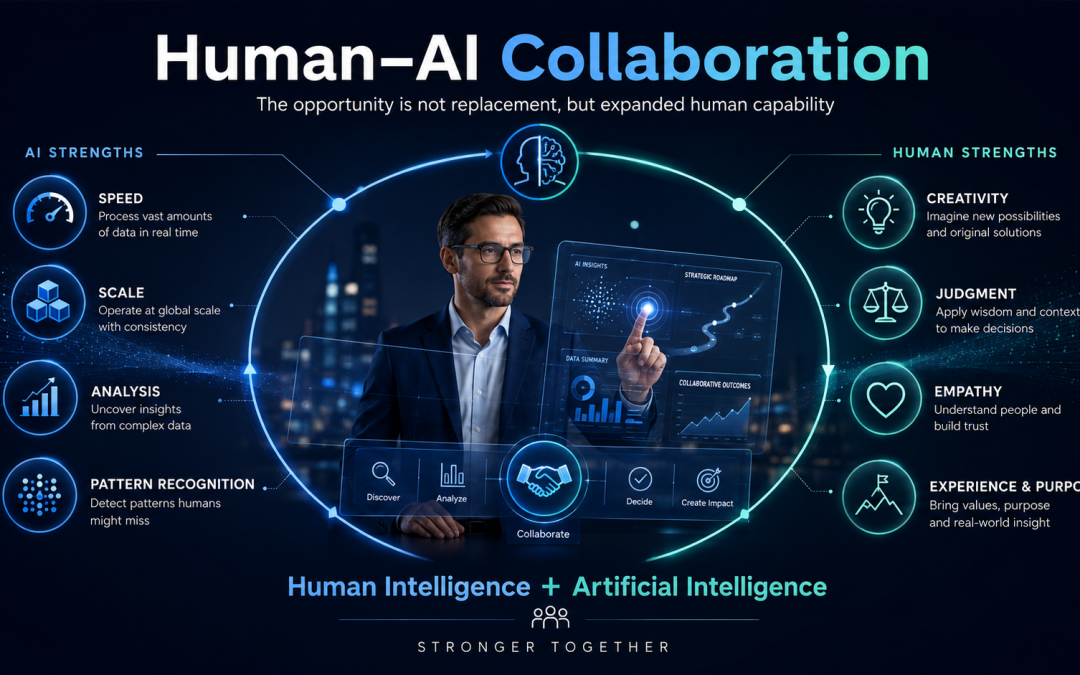
Human–AI Collaboration: The Larger Opportunity Beyond Automation is helping expand what human beings can accomplish with artificial intelligence.
Much of the public and business conversation still revolves around automation. Which tasks can be completed faster? Which repetitive activities can be transferred to machines? Which processes can operate with less human intervention?
These are important questions. Automation can undoubtedly improve efficiency and productivity. But it does not capture the full scope of the opportunity created by artificial intelligence. The greater opportunity lies in combining the strengths of human intelligence with those of increasingly capable AI systems.
From Automation to Augmentation
AI already helps professionals research, analyze information, create content, develop software, organize knowledge, and support complex decisions. Its value, however, extends beyond individual tasks. Modern professionals and organizations operate in an environment of extraordinary information abundance.
Reports, research papers, emails, operational records, market data, images, audio, video, and constantly evolving digital information are generated at a scale unimaginable only a generation ago. AI can help organize this complexity.
It can examine large volumes of information, identify patterns, retrieve relevant knowledge, summarize competing perspectives, and generate possible alternatives. This can improve understanding. But people must still determine what the information means.
AI can strengthen decision-making. But people must still consider priorities, values, consequences, and the interests of those affected. AI can help generate text, software, images, presentations, and new ideas. But human creativity still provides intention, direction, taste, and purpose. AI can also help researchers discover hidden relationships and identify promising avenues for investigation. But human specialists must validate the evidence and determine its significance.
The objective, therefore, should not simply be to remove human intelligence from work. It should be to give human intelligence greater reach.
A Different Model of Human–AI Collaboration
Human–AI collaboration is not a vision in which people surrender their responsibilities to machines. Nor is it simply a more sophisticated form of office automation.
It is a working relationship in which people define the objective, AI processes information and explores possibilities, and humans interpret the results and remain accountable for what happens next. This distinction is important.
AI systems can process information at remarkable speed and scale. They can assist with pattern recognition, comparison, retrieval, drafting, simulation, and analysis. But human beings provide context. They understand institutional history, relationships, values, trade-offs, and consequences. They determine priorities. They decide when an answer is technically correct but practically inappropriate. And they remain responsible for decisions that affect other people.
The strongest model of AI use is therefore neither “human instead of AI” nor “AI instead of human.” It is human intelligence working with artificial intelligence.
AI as a General-Purpose Technology
Artificial intelligence is increasingly being compared with earlier technologies that transformed entire economies.
Steam power changed manufacturing and transportation.
Electricity reshaped factories, cities, communication, and everyday life.
The internet connected people, information, markets, and institutions. Cloud computing made large-scale digital resources available without requiring every organization to maintain all of its own computing infrastructure. AI may represent the next stage in this progression.
It is more than just another digital tool because it is not confined to a single task, profession, or industry.
- AI can support analysis in healthcare.
- It can improve forecasting in agriculture.
- It can enable personalized assistance in education.
- It can strengthen risk assessment in finance.
- It can assist quality control in manufacturing.
- It can accelerate scientific research.
- And it can support decision-making across business, government, and professional services.
As with earlier transformative technologies, its value is likely to grow as the technology improves, infrastructure expands, organizations gain experience, and new applications emerge.
The Larger Transformation Will Come From Redesigning Work
The history of technology suggests that the greatest impact of a general-purpose technology does not come merely from inserting it into existing processes.
Electricity did not simply make factories brighter.
It eventually changed how factories were designed.
The internet did not simply make communication faster.
It created new markets, industries, services, and forms of social interaction. AI may follow a similar path. Its most significant effects may not come from simply attaching AI tools to existing workflows. They may emerge when organizations begin redesigning work around the complementary strengths of humans and intelligent systems.
That could mean new ways of conducting research. New approaches to professional services. Different models of education and training. Faster scientific discovery. More sophisticated decision support. And entirely new products, services, and organizational structures that are difficult to anticipate today.
AI should therefore increasingly be understood as an enabling capability across the economy rather than simply another application installed on a computer.
The Question Is Changing
The conversation around artificial intelligence is gradually moving beyond the question:
What can AI do?
A more consequential question is emerging:
What can people and intelligent systems accomplish together?
That question shifts the discussion from replacement to augmentation. From automation to collaboration. From technology alone to combined capability. And perhaps most importantly, from the capabilities of machines to the expanded possibilities available to human beings. That may ultimately be the larger opportunity created by artificial intelligence.