
Which industries are leading the AI revolution is the question, as the technology has moved well beyond the stage of experimentation. What was once considered a specialized technology for research laboratories and large technology companies is now becoming a fundamental capability across the global economy.
Organizations in virtually every sector are exploring how AI can improve productivity, enhance decision-making, accelerate innovation, and create new business opportunities. Yet adoption is not occurring at the same pace everywhere. Some industries are already realizing measurable business value, while others remain in the early stages of developing the infrastructure, governance, and workforce capabilities needed for enterprise-scale implementation.
This raises an important question:
Which industries are leading the AI revolution—and why?
Defining AI Leadership
Leadership in Artificial Intelligence cannot be measured using a single metric.
Some organizations invest heavily in AI research and development. Others focus on deploying AI across business functions. Some generate significant financial returns from AI-enabled products and services, while others create value by improving operational efficiency or enhancing customer experiences.
Several indicators help assess AI leadership:
- AI adoption across the organization
- Business value generated
- Investment in AI technologies
- Market spending
- Breadth of deployment
- Expected future growth
- Organizational capability and maturity
Although different research organizations emphasize different measures, a remarkably consistent picture emerges.
Studies by organizations including McKinsey & Company, Bain & Company, PwC, Coursera, and Grand View Research consistently identify the same industries as today’s AI leaders.
The First Wave of AI Leaders
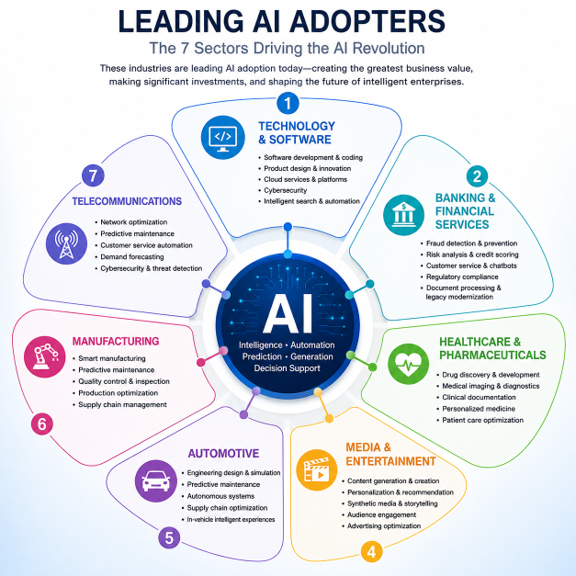
The industries leading enterprise AI adoption include:
- Technology and Software
- Banking and Financial Services
- Healthcare and Pharmaceuticals
- Media and Entertainment
- Telecommunications
- Automotive
- Manufacturing
Each of these industries has begun integrating AI into both customer-facing services and internal operations.
Technology companies use AI to develop intelligent software, coding assistants, recommendation engines, cybersecurity solutions, and cloud platforms.
Financial institutions employ AI for fraud detection, credit assessment, algorithmic trading, regulatory compliance, and personalized financial services.
Healthcare organizations are applying AI to medical imaging, drug discovery, clinical decision support, patient engagement, and administrative automation.
Manufacturers use AI to optimize production planning, predictive maintenance, quality assurance, supply chains, and robotics.
Media companies increasingly rely on AI for content creation, recommendation systems, audience analysis, localization, and advertising optimization.
Although these sectors appear very different, they share several important characteristics.
The Common Thread: Knowledge Work
Why have these industries become AI leaders?
The answer is not simply that they possess larger technology budgets. Their real advantage lies elsewhere. They generate enormous volumes of digital information.
They depend on research, engineering, customer interaction, data analysis, scientific discovery, and complex decision-making. Much of their competitive advantage depends upon how effectively they acquire, process, interpret, and apply knowledge.
Artificial Intelligence is exceptionally well suited to these environments.
Unlike traditional software, AI can work directly with knowledge. It can retrieve information, recognize patterns, summarize documents, generate reports, support decision-making, analyze images, interpret language, and create new digital content.
In many organizations, knowledge work represents one of the largest opportunities for productivity improvement.
This explains why AI is creating value so rapidly in these sectors.
Beyond Automation
Many organizations still approach AI primarily as an automation technology.
While automation certainly delivers benefits, this perspective captures only part of AI’s potential. The larger opportunity lies in augmenting human intelligence.
Doctors gain faster access to medical knowledge, engineers evaluate more design alternatives, scientists analyze larger datasets, financial analysts detect emerging risks earlier, software developers accelerate coding and testing, executives receive faster access to strategic insights.
In each case, AI complements professional expertise rather than replacing it. The result is not simply faster work. It is better-informed decision-making.
AI as Enterprise Capability
This distinction highlights an important difference in how organizations approach Artificial Intelligence.
Some treat AI as another software application added to existing workflows.
Others view AI as a foundational organizational capability.
The difference is significant. Organizations that focus only on isolated use cases often achieve incremental improvements—such as automating reports, generating content, or improving customer support.
Organizations that view AI as an enterprise capability begin asking broader questions.
- How should workflows be redesigned?
- Which decisions can be supported by AI?
- How should knowledge flow across the organization?
- How should governance evolve?
- What new products and business models become possible?
These questions move AI from an IT initiative to a strategic transformation program.
The Next Competitive Advantage
History demonstrates that transformative technologies rarely create their greatest value by improving existing processes alone.
Electricity did not simply replace steam engines.
It transformed factory design.
The internet did not merely accelerate communication.
It created entirely new industries and business models.
Artificial Intelligence is likely to follow a similar path.
Its greatest impact will emerge as organizations redesign work around the complementary strengths of human expertise and machine intelligence.
Looking Ahead
Today’s AI leaders may not necessarily remain tomorrow’s leaders. As AI platforms become more accessible and agentic AI systems mature, competitive advantage will depend less on purchasing technology and more on organizational learning.
The organizations that succeed will not simply deploy AI tools. They will build cultures that continuously integrate AI into decision-making, innovation, customer engagement, and knowledge work.
The next phase of digital transformation is therefore unlikely to be defined by technology adoption alone. It will be defined by organizational adaptation.
Those who learn fastest, redesign work most effectively, and combine human and artificial intelligence most successfully are likely to shape the next generation of enterprise leadership.
Final Thoughts
Artificial Intelligence is no longer confined to one department, one profession, or one industry.
It is becoming part of the knowledge infrastructure of the digital economy.
The industries leading the AI revolution today offer valuable lessons for every organization. Their experience demonstrates that AI delivers its greatest value not when it replaces people, but when it enables people to work more intelligently, make better decisions, and create new possibilities.
In the years ahead, the question will not be which industries use AI.
The question will be which organizations learn to most effectively combine human expertise with artificial intelligence.
This article is part of my AI Explained series, which explores Artificial Intelligence, Machine Learning, Large Language Models, Agentic AI, and the strategic implications of AI for business, government, and society.